Pages

Sunday, June 9, 2013

Marie Laurencin through July!

A few months ago, I posted about the Marie Laurencin exhibit at the Musee Marmottan Monet. 

The museum has now extended the end date of the exhibit through July 21st. 


This summer pull together a group of friends and discover Marie's pleasant and fanciful world ...

Love,
CSL


Sunday, June 2, 2013

Le Domaine de Sceaux

It`s nearly summer and the weather in Ile-de-France is finally warm enough to enjoy an occasional sunny weekend in the park. The city of Paris is famous for its beautiful gardens in which artists and thinkers have wandered for centuries. They are lovely places to stroll, have an ice cream cone and elegantly sprawl out on a green metal chair by a fountain while watching children play with toy boats.

Just across the peripherique there are a large number wooded areas that are bursting out into summer bloom. In these domaines you can ride bikes or even hike since they cover much larger areas than the parks inside of the capitol. For example, the Bois de Boulogne offers so many playgrounds and garden paths it would take the entire summer to discover them all. June is the ideal time of year to visit the Bois de Boulogne's rose garden at Bagatelle which will be full of blossoms all month long. Rose enthusiasts should also visit the garden at l'Hay-les-Roses. It's a little further outside of the city, but worth the detour on a weekend. Note that this garden will be closed on certain days this month because of a special treatment given to diseased rose bushes so make sure to check the dates on their website before heading out.

During the month of June, I've decided to put together a selection of my favorite parks around Paris. The Parc de Sceaux, The Vallee aux Loups with Chateaubriand's mansion, Rambouillet and for my fellow food enthusiasts, the potager du roi in Versailles.

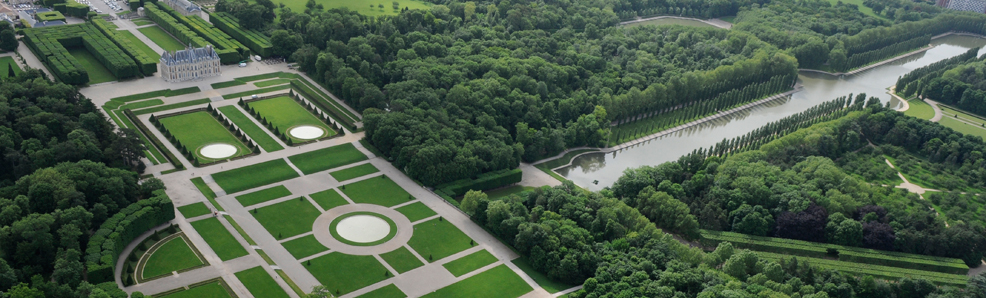
Aerial view of the Parc de Sceaux with its parterres descending from the chateau. Designed for Colbert by Andre Le Notre

The Parc de Sceaux was designed by Andre Le Notre for Prime Minister Colbert in the days of Louis XIV. Le Notre, in his signature style, installed a canal that unfolds symmetrically underneath a rushing waterfall, evenly spaced out plane and chestnut trees around the waterway, and included a majestic view over parterres that descends from the chateau to the edge of the park. Bike riders today can catch the coulee verte, a path that leads from Paris to Massy, at this exit. There are many grassy areas for picnicks, kicking around a soccer ball, or setting up a badminton net. During hot summer days, try the outdoor swimming pool at the grenouillere.

The Domaine de Sceaux is a weekend rendez-vous for local joggers, in the late afternoon young families show up and the park is full of toddlers shuffling little wooden tricycles around with their feet and adolescents playing ball games in the large open field that sprawls over a hillside, or chatting in one of the intimate pathways that meander through the wooded areas.

I strongly suggest visiting the chateau's interior. Although the original building constructed by Colbert has been torn down, the nineteenth century residence of the Trevise family has beautiful furniture and some very interesting paintings from all the previous residents of the domain: the Colberts in the seventeenth century, the duc de Maine and Penthievres in the eighteenth century and the Trevise in the nineteenth century. The stables have been renovated into a special exhibit hall where some very poignant studies have been presented over the past years. At the moment paintings that were hung in the Grande Galerie at the Louvre for Louis XIV in 1704 are exhibited. There is also an outdoor photography exhibit displaying photos of buildings throughout the Hauts-de-Seine department.

The domain regularly organizes events within the park. To celebrate Andre Le Notre's 400th birthday, special events are planned on weekends throughout the year. On June 29 and 30 take a free themed tour of the garden "Andre Le Notre and the Jardin a la francaise". On the 14 and 15 of this month an open air performance of The Magic Flute is scheduled. And during July and August the annual Festival de l'Orangerie will bring chamber music into the gardens.

This month, take a few daring steps across Paris' threshold and discover the wealth of outdoor activities all around us. Next week, I'll tell you about the most enchanted forest in the Paris region : La Vallee aux Loups, where Romantic author Chateaubriand built his snug little residence in the early nineteenth century.

-CSL

Domaine de Sceaux
Parc et Musee de l'Ile de France
Website
Access by RER B: Parc de Sceaux, Bourg-la-Reine or La Croix de Berny
Open everyday from sunrise to sunset
Museum hours:
10am-1pm and 2pm-5pm
Museum closed on Tuesdays


Saturday, May 4, 2013

Ettore Sottsass at Sèvres, Cité de Céramique

Photo courtesy G. Jonca/Sevres
Cite de la ceramique.
An architect in the workshop, is the title (translated) of the current exhibit in the national porcelain manufacture at Sèvres' museum space. The architect in question is Ettore Sottsas; architect and designer, creator of the Valentine typewriter and the Carlton bookcase. He is also the father of the Memphis group (1981-1988) a group of designers who were at the crux of a style that is called postmodern design. In 1993, Sèvres invited Sottsass to imagine a series of pieces in porcelain. In collaboration, they discovered new forms and formulas for glazes, and produced vases that are now iconic figures of Sottsass' style.


Vase Sybilla, 1994. Photo courtesy G. Jonca/
Sevres Cite de la ceramique.
The china vases are superposed brightly colored shapes and look like totems or the vague outline of a person. The vase "Sybilla" for example, is made of two colored bell shapes separated by a ring of "biscuit" (unglazed porcelain) suggesting the silhouette of an orange skirt and black top held together by a white belt. This particular shade of orange is one of the colors studied by the manufacture for Sottsass' productions. I particularly liked the vases "Diane" and "Lucrèce". The former is in purple, white and red, and the latter in cream and a deep blue (a color that Sèvres is famous for). They both have forms lined with gold leaf that reflects light so brilliantly that they could be mistaken for table lamps.

A second collection of vases were created in 2006 and mix Sèvres porcelain with glass works from CIRVA a state funded experimental glass manufacture in Marseille. Glass elements are suspended from porcelain bowls with thick strings. The effect is a little disturbing because the roughness of the ropes offsets the nobility of the main materials. The idea of suspending large pieces of glass like windchimes is also unsettling. In a series of glassworks created by the CIRVA between 1999 and 2004 shapes of colored glass are suspended from, around, inside or outside of the vase portion of the glass. The shapes are complex and uneven.

Kachina 10, (2006-2012) CIRVA, Marseille,
ed. Galerie Mourmans, Maastricht.
Sottsass' simple shapes hide a deeper philosophy about the nature of design that he felt presented a "sort of figurative and metaphoric utopia of life". The pieces presented here are indeed architectures as the title of the exhibit suggests, but they are also little realms reproducing the fragility of life and people. In his later pieces with the CIRVA, Ettore Sottsass created many different shapes suggestive of human figures and called them "Kachinas" This, of course, is a reference to the Native American cult in which hundreds of deities are designated as spirits of different natural elements, sun, moon, trees, etc. The reference to the spiritual reminds us that while his art is very amusing, there is also a deeply mystical side to Sottsass' creative process.

Sottsass passed away on December 31, 2007.

The Manufacture nationale de Sèvres descends from a manufacture established in Vincennes by Madame de Pompadour in 1740. This manufacture was specialized in a special ceramic mixture called "porcelaine à pâte tendre" for its soft texture. In 1756 the workshop was transferred to Sèvres. A short time later it fell under control of King Louis XV. Following the discovery of kaolin in Limoges (kaolin or china clay is used to make traditional porcelain "à pâte dure") the royal manufacture began producing a greater variety of products starting in 1770. The manufacture and its collections were moved to their current spot on the banks of the Seine in 1876.

Sèvres - cité de céramique has a collection of mainly ceramics, but also some glass pieces gathered for research purposes and as sources of inspiration in the creation of pieces at the porcelain manufacture. Alexandre Brogniart, who was administrator from 1800-1847 established the museum. The museum building itself is a beautiful piece of classical looking architecture that separates the porcelain workshops, research and store rooms from the Seine. The permanent collections are a beautiful and fascinating tour of the history of porcelain and various techniques.

Ettore Sottsass - un architecte dans l'atelier
Through July 22, 2013

Cité de la Céramique - Sèvres
2 place de la Manufacture
92310 Sèvres

Opening hours:
10am - 5pm everyday except Tuesday.

Museum website