Pages

Sunday, July 19, 2015

Jeanne Lanvin at the Musée Galliera


Jeanne Lanvin was a woman with a passion for dressing women well. The timeless chic of the pieces exhibited at the Palais Galliera through August 23rd reflect this genius.
« Jeanne Lanvin drapant un tissu sur un mannequin » par Laure Albin Guillot © Laure Albin Guillot / Roger-Viollet 

Sunday, June 16, 2013

Rambouillet, the chateau and the forest

About an hour long train ride from Montparnasse, the domain Rambouillet is a lovely spot to visit all year round. The chateau, gardens and surrounding forest are full of history, sites to see, and things to do.
copyright CMN/ Didier Plowy

Sunday, June 9, 2013

La Vallee aux Loups

The name is magical. The valley of wolves sounds haunting and enchanted. It's the perfect name for Romantic French author Chateaubriand's country residence, hidden away in the hilly landscape of Chatenay-Malabry just west of the French capital.


Marie Laurencin through July!

A few months ago, I posted about the Marie Laurencin exhibit at the Musee Marmottan Monet. 

The museum has now extended the end date of the exhibit through July 21st. 


This summer pull together a group of friends and discover Marie's pleasant and fanciful world ...

Love,
CSL


Sunday, June 2, 2013

Le Domaine de Sceaux

It`s nearly summer and the weather in Ile-de-France is finally warm enough to enjoy an occasional sunny weekend in the park. The city of Paris is famous for its beautiful gardens in which artists and thinkers have wandered for centuries. They are lovely places to stroll, have an ice cream cone and elegantly sprawl out on a green metal chair by a fountain while watching children play with toy boats.

Just across the peripherique there are a large number wooded areas that are bursting out into summer bloom. In these domaines you can ride bikes or even hike since they cover much larger areas than the parks inside of the capitol. For example, the Bois de Boulogne offers so many playgrounds and garden paths it would take the entire summer to discover them all. June is the ideal time of year to visit the Bois de Boulogne's rose garden at Bagatelle which will be full of blossoms all month long. Rose enthusiasts should also visit the garden at l'Hay-les-Roses. It's a little further outside of the city, but worth the detour on a weekend. Note that this garden will be closed on certain days this month because of a special treatment given to diseased rose bushes so make sure to check the dates on their website before heading out.

During the month of June, I've decided to put together a selection of my favorite parks around Paris. The Parc de Sceaux, The Vallee aux Loups with Chateaubriand's mansion, Rambouillet and for my fellow food enthusiasts, the potager du roi in Versailles.

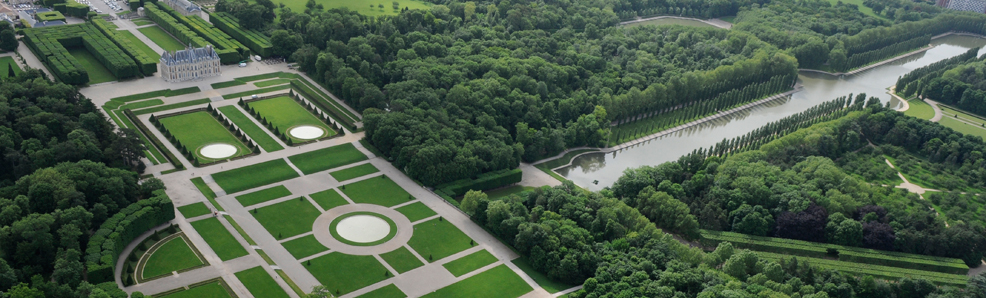
Aerial view of the Parc de Sceaux with its parterres descending from the chateau. Designed for Colbert by Andre Le Notre

The Parc de Sceaux was designed by Andre Le Notre for Prime Minister Colbert in the days of Louis XIV. Le Notre, in his signature style, installed a canal that unfolds symmetrically underneath a rushing waterfall, evenly spaced out plane and chestnut trees around the waterway, and included a majestic view over parterres that descends from the chateau to the edge of the park. Bike riders today can catch the coulee verte, a path that leads from Paris to Massy, at this exit. There are many grassy areas for picnicks, kicking around a soccer ball, or setting up a badminton net. During hot summer days, try the outdoor swimming pool at the grenouillere.

The Domaine de Sceaux is a weekend rendez-vous for local joggers, in the late afternoon young families show up and the park is full of toddlers shuffling little wooden tricycles around with their feet and adolescents playing ball games in the large open field that sprawls over a hillside, or chatting in one of the intimate pathways that meander through the wooded areas.

I strongly suggest visiting the chateau's interior. Although the original building constructed by Colbert has been torn down, the nineteenth century residence of the Trevise family has beautiful furniture and some very interesting paintings from all the previous residents of the domain: the Colberts in the seventeenth century, the duc de Maine and Penthievres in the eighteenth century and the Trevise in the nineteenth century. The stables have been renovated into a special exhibit hall where some very poignant studies have been presented over the past years. At the moment paintings that were hung in the Grande Galerie at the Louvre for Louis XIV in 1704 are exhibited. There is also an outdoor photography exhibit displaying photos of buildings throughout the Hauts-de-Seine department.

The domain regularly organizes events within the park. To celebrate Andre Le Notre's 400th birthday, special events are planned on weekends throughout the year. On June 29 and 30 take a free themed tour of the garden "Andre Le Notre and the Jardin a la francaise". On the 14 and 15 of this month an open air performance of The Magic Flute is scheduled. And during July and August the annual Festival de l'Orangerie will bring chamber music into the gardens.

This month, take a few daring steps across Paris' threshold and discover the wealth of outdoor activities all around us. Next week, I'll tell you about the most enchanted forest in the Paris region : La Vallee aux Loups, where Romantic author Chateaubriand built his snug little residence in the early nineteenth century.

-CSL

Domaine de Sceaux
Parc et Musee de l'Ile de France
Website
Access by RER B: Parc de Sceaux, Bourg-la-Reine or La Croix de Berny
Open everyday from sunrise to sunset
Museum hours:
10am-1pm and 2pm-5pm
Museum closed on Tuesdays


Saturday, May 4, 2013

Ettore Sottsass at Sèvres, Cité de Céramique

Photo courtesy G. Jonca/Sevres
Cite de la ceramique.
An architect in the workshop, is the title (translated) of the current exhibit in the national porcelain manufacture at Sèvres' museum space. The architect in question is Ettore Sottsas; architect and designer, creator of the Valentine typewriter and the Carlton bookcase. He is also the father of the Memphis group (1981-1988) a group of designers who were at the crux of a style that is called postmodern design. In 1993, Sèvres invited Sottsass to imagine a series of pieces in porcelain. In collaboration, they discovered new forms and formulas for glazes, and produced vases that are now iconic figures of Sottsass' style.


Vase Sybilla, 1994. Photo courtesy G. Jonca/
Sevres Cite de la ceramique.
The china vases are superposed brightly colored shapes and look like totems or the vague outline of a person. The vase "Sybilla" for example, is made of two colored bell shapes separated by a ring of "biscuit" (unglazed porcelain) suggesting the silhouette of an orange skirt and black top held together by a white belt. This particular shade of orange is one of the colors studied by the manufacture for Sottsass' productions. I particularly liked the vases "Diane" and "Lucrèce". The former is in purple, white and red, and the latter in cream and a deep blue (a color that Sèvres is famous for). They both have forms lined with gold leaf that reflects light so brilliantly that they could be mistaken for table lamps.

A second collection of vases were created in 2006 and mix Sèvres porcelain with glass works from CIRVA a state funded experimental glass manufacture in Marseille. Glass elements are suspended from porcelain bowls with thick strings. The effect is a little disturbing because the roughness of the ropes offsets the nobility of the main materials. The idea of suspending large pieces of glass like windchimes is also unsettling. In a series of glassworks created by the CIRVA between 1999 and 2004 shapes of colored glass are suspended from, around, inside or outside of the vase portion of the glass. The shapes are complex and uneven.

Kachina 10, (2006-2012) CIRVA, Marseille,
ed. Galerie Mourmans, Maastricht.
Sottsass' simple shapes hide a deeper philosophy about the nature of design that he felt presented a "sort of figurative and metaphoric utopia of life". The pieces presented here are indeed architectures as the title of the exhibit suggests, but they are also little realms reproducing the fragility of life and people. In his later pieces with the CIRVA, Ettore Sottsass created many different shapes suggestive of human figures and called them "Kachinas" This, of course, is a reference to the Native American cult in which hundreds of deities are designated as spirits of different natural elements, sun, moon, trees, etc. The reference to the spiritual reminds us that while his art is very amusing, there is also a deeply mystical side to Sottsass' creative process.

Sottsass passed away on December 31, 2007.

The Manufacture nationale de Sèvres descends from a manufacture established in Vincennes by Madame de Pompadour in 1740. This manufacture was specialized in a special ceramic mixture called "porcelaine à pâte tendre" for its soft texture. In 1756 the workshop was transferred to Sèvres. A short time later it fell under control of King Louis XV. Following the discovery of kaolin in Limoges (kaolin or china clay is used to make traditional porcelain "à pâte dure") the royal manufacture began producing a greater variety of products starting in 1770. The manufacture and its collections were moved to their current spot on the banks of the Seine in 1876.

Sèvres - cité de céramique has a collection of mainly ceramics, but also some glass pieces gathered for research purposes and as sources of inspiration in the creation of pieces at the porcelain manufacture. Alexandre Brogniart, who was administrator from 1800-1847 established the museum. The museum building itself is a beautiful piece of classical looking architecture that separates the porcelain workshops, research and store rooms from the Seine. The permanent collections are a beautiful and fascinating tour of the history of porcelain and various techniques.

Ettore Sottsass - un architecte dans l'atelier
Through July 22, 2013

Cité de la Céramique - Sèvres
2 place de la Manufacture
92310 Sèvres

Opening hours:
10am - 5pm everyday except Tuesday.

Museum website

Sunday, April 21, 2013

Now at the Galerie Galatee "Paysages Suspendus" engraver Marine Lefebvre dreams of childhood and tree bark


It was a rainy evening about a month ago, when I first stumbled on the Galerie Galatée, a small art gallery in the rue Notre Dame de Nazareth specialized in modern engravings. The evening was festive and simple, lights in the gallery flooded out the streets with their yellow glow and the sweet jazzy notes of O Forte, a four piece group from Toulouse whose music compliments engraver Marine Lefebvre's sweet yet sober compositions.

The engravings are captivating: a superposition of different textures brought to life by the bite of acid on copperplate. The forms are suggestive of many different elements: tree bark or muscle tissue. They melt one into another. Gallery owner, Ghizlaine Jahidi says this "hybridation" attracted her to Marine Lefebvre's artworks immediately. She sees in these engravings an unconscious reference to the Swedish painter Munch, Lefebvre "gives a tragic dimension to beauty." This is especially apparent in the triptych "Palingenèse par les hauteurs" (Palingenesis/Rebirthing from Above). In one of the three engravings that form the triptych, a faceless black form peers around streaks of black and white. Looming over these elements is a pair of feet that seem to be walking out of the painting.


In the series "Marcigny" Lefebvre reflects on her childhood experiences in the little Burgundy village where
her grandparents lived. By mixing motifs from her memories with close-ups of organic materials she creates a space of utopic otherness, that Lefebvre calls "heterotopias" (the term heterotopia was created by Michel Foucault in reference to a space that is outside of the physical world but runs parallel to it such as the places where children hide to play in the backyard, or in their parents' bed). For me these engravings resemble a slice of the artist's imagination cut from her mind and displayed the way dynamited rock on mountain roads allow passersby to discover millions of years of geological history. A series of photographs on the artist's website help to understand the ecological influence on these engravings (photographie Espaces Vides).
Marine Lefebvre poses in front of the series "Marcigny"
at the Galerie Galatée
Lefebvre is currently training at the Ecole des Arts Decoratifs in Paris. She began her studies in set design, but recently discovered a preference for the autonomy and the sensation of engraving. Over the past year she has spent time in a  Ireland at a workshop where she could exchange with engravers from all over the world. Back in Paris she started printing in René Tazé's workshop. Tazé is one of the top printers in the city, and his long career makes him an excellent model for Lefebvre.

Marine Lefebvre's work seems to be made for a gallery like Galatee. Owner Ghizlaine Jahidi opened her doors a little over a year ago in a part of the city where the art scene is beginning to blossom. Jahidi has always been drawn to engravings, a medium that she finds brings the spectator into an intimate "proximity to the artist." Since opening she has been dealing with contemporary engravings: some major names such as Max Klinger and Eric Desmazières. Lefebvre's shadow crossed her threshold at a moment when she had been on the lookout for new talent.

The exhibit "Paysages Suspendus" (Suspended Landscapes) is scheduled at the Galerie Galatée through mid-May. These engravings have an enchanting melancholy that is lovely to observe (and the prices are quite reasonable).


Address:
31 rue Notre-Dame de Nazareth, Paris 9e
Hours:
Tuesday - Saturday : 1pm-7pm
Métro:
Temple ou République
Email

Link to Marine Lefebvre's website


Sunday, March 17, 2013

Marie Laurencin at the Musee Marmottan Monet

Soft pinks and greys, sweet faces and sad black eyes, this Spring in the Jardins de Ranelagh, the Musee Marmottan Monet is exhibiting a selection of paintings by Marie Laurencin.

The name Marie Laurencin rings a bell in the minds of both 20th century literature and art enthusiasts without necessarily evoking her own career as a painter. In the 1920s and 30s, Marie's paintings were acclaimed throughout Paris, but history books have often preferred to speak of her relationships with other artists: her long love affair with Guillaume Apollinaire, her interactions with American writers such as Gertrude Stein and her Sappho inspired trysts in various women's salons throughout Paris.

This season, Parisians have the opportunity to take a look at Laurencin's artistic career as the Musee Marmottan-Monet exhibits a large selection of her paintings, mainly on loan from the Marie Laurencin Museum of Tokyo (the only known museum dedicated to the artist's work). The exhibit allows us to discover her sensitive and original style, and we come to understand how this very original artist fits right in to the art of her time creating her own style while receiving influence from cubists Braque and Picasso, as well as the from the painter Le Douanier Rousseau.

My favorite work in the exhibit is a watercolor of a woman holding a basket of fruit on her head. One black, almond-shaped eye draws you in to a whirlpool of hand, basket, black braid and neck. Each element of the woman's body is at once separated and idealized and then combined by the composition's movement. It has a sensual and calculated beauty that is irresistible.The drawing is dated between 1908 and 1910, period when Marie Laurencin was in contact with Braque, Picasso, Apollinaire, and studying her own manner of cubic perspective, her signature style.


Marie Laurencin, Les deux espagnoles, 1915.
Copyright Adagp, 2012
During the first world war, Marie lived in exile in Madrid, having married a German baron just before the war broke out. Although the situation was difficult and lonely, she continued to paint and her paintings adopted elements of the surrounding culture, like the folding fan and lace mantilla in the painting, Les deux espagnoles. These Spanish women are transported into Laurencin's world of child-like reverie, with a note of melancholy. The choice of colors is her recurrent theme of grey tones and pastel pink with a bit of blue, green or red. The long ovals that form the women's faces and their long, thin, spidery fingers are specific to her work.


Marie Laurencin, La vie au chateau, 1925. Copyright Adagp, 2012.
La vie au chateau is a romp in a fairy tale park, with a series of portraits of women in different attitudes, painted in 1925. I believe it was exhibited in the 1925 Paris World's Fair that set French interior design on the international scene.

Back in Paris after the Armistice, Marie Laurencin received an increasing amount of recognition and entered the high point of her career. These years lead her to artistic maturity. By 1925 she was acclaimed throughout the city, and often commissioned to paint the portraits of important figures of Paris (mostly women): Coco Chanel and the baroness Gourgaud for example. She also dabbled in illustrations, and set designs (for Cocteau and the Ballets Russes).

The exhibit in the Musee Marmottan Monet is a rare opportunity to see such an important quantity of Marie Laurencin's paintings and sketches outside of Tokyo. The exhibit catalogue is also excellent. Daniel Marchesseau (ex-director of the Musee de la Vie Romantique) recounts the story of Marie Laurencin's art in French accompanied by a very good translation into English. It's a pleasure to read, both intellectually stimulating and easily accessible to someone who has no background knowledge in the subject. A great book to pick up on a rainy Sunday afternoon.

-CSL

Marie Laurencin 1883-1956
through June 30, 2013

Musee Marmottan Monet
2 rue Louis Boilly
75016 Paris

Opening hours:
Tuesday - Sunday: 10am - 6pm
Open Thursdays until 8pm

Museum website link


Sunday, February 10, 2013

The New Frontier at the Louvre : Genre Scenes in Nineteenth Century American Art

George Caleb Bingham, The Jolly Flatboatmen, 1877-1878,
Terra Foundation for American Art
copyright Terra Foundation for American Art, Chicago


On January 19 in the Gainsbourough room, the Louvre inaugurated New Frontier II the second part of a series of four exhibits of paintings from the United States before and around the Civil War. This year's installment shows a handful of genre scenes - scenes showing activities from daily life - popularized during the 1830s and 40s at a time when the American identity became increasingly diverse as the country spread out farther west.

Three paintings stand out from this exposition dossier and show three recurrent themes in American genre painting: social commentary for The Old Kentucky Home or Life in the South, by Eastman Johnson, 1870, (High Museum of Art, Atlanta); light, atmosphere subjects with The Jolly Flatboatmen, by George Caleb Bingham (see illustration); and Far West subjects in The Life of a Hunter - a Tight Fix by Arthur Fitzwilliam Tait, 1856, (Crystal Bridges Museum of American Art). But the exhibit also covers the change in painting influences during this time.

Guillaume Faroult, curator of this exhibition, is curator of English, US and Australian paintings at the Louvre. In a telephone conversation last week, he spoke with enthousiasm about New Frontier and the painters selected for the current exhibit. He said that because Johnson and Bingham were among the first American painters to "couper le cordon avec l'Angleterre" (translation: cut the ties - implying the umbilical cord - with England) they were interesting choices. Both painters trained in Dusseldorf and were influenced by 17th century Dutch genre paintings notably the work of Jan Steen. The Louvre did not miss out on the opportunity to show the three painters together for the first time. Visitors to the exhibit can compare the similitude between the gestures and expressions of Bingham's Jolly Flatboatmen, on loan from the Terra Foundation and Steen's Joyeux repas de famille from the Louvre's collection.

German-born Emmanuel Leutze (Washington Crossing the Deleware) was also a member of the Dusseldorf School. The exhibit displays a scene from a series of Leutze's paintings on the story of Christopher Columbus (a recent gift from the American Friends of the Louvre association). This painting makes a final statement about American genre painting in that Leutze's historical subject is executed in the smaller genre painting format.

Monsieur Faroult also explained the roles of three American partners participating in the New Frontier venture: the Chicago based Terra Foundation, the High Museum of Art in Atlanta, and the brand-new Crystal Bridges Museum of American Art in Bentonville, Arkansas.

The Terra Foundation promotes American Art throughout the world participating in exhibitions and symposiums. They are very present in Paris with a research center and have also been actively working with the Louvre on several projects since the early 2000s, of which the Lafayette database that gathers information relating to American paintings in European museums. The High Museum of Art has a large collection of American art based in Atlanta. Over a period of three years (2006-2009), they exhibited works from the Louvre in Atlanta.

The Crystal Bridges Museum that opened in 2011, has a collection of lesser known and historical American paintings. These types of art works provide an interesting addition to the exhibits. Their current contribution is the painting by Tait, an action-packed illustration destined to make the observer hold his breath in worried anticipation as he unfolds the elements of the scene: a kneeling hunter pulls back his arm preparing a knife-blow to the abdomen of a snarling, wounded black bear. The bear has managed to wrestle the hunter's rifle away from him and is standing on it. Who will win the battle? Perhaps the hunter's friend, poised to shoot in the background, is aiming at the ferocious beast, but is he looking in the right direction?

The selection of paintings shown in New Frontier II introduces us to a new and intriguing subject. Luckily there are options if you would like to see more. The exhibit catalogue - with an essay by Peter John Brownlee of the Terra Foundation - is available in French in the Louvre bookshop, along with Guillaume Faroult's essay on Thomas Cole from the first installment of New Frontier on landscape paintings (published in English). There is also a series of conferences, mostly on Monday evenings, scheduled in the Louvre auditorium this month.

After that we'll have to wait until 2014 for the next New Frontier installment. Monsieur Faroult indicated the theme will be portraits. For the occasion, Charles Wilson Peale's portrait of George Washington that was given to Louis XVI by the American people as a thank you gift following the American Revolution will be exhibited for the first time since its recent restoration!

- CSL


Paris Notes and the American Clubs would like to thank Guillaume Faroult for his explanations about the exhibit and the Louvre's plans for developing interest in art from the North American continent.

NEW FRONTIER II
through April 22, 2013
at the Louvre
Denon wing, First floor, Room 32 (Salle Gainsborough)

Opening hours:
Wednesday through Monday
9:30 am-5:30 pm
Evening hours on Wednesday and Friday to 9:30 pm


Saturday, January 19, 2013

Le japonisme at the Manufacture Prelle

Japan fascinates. Throughout the world, people seem to fall head-over-heels in love with the Japanese way of life: the cuisine, the etiquette, the art. In the late 19th century, all of Europe was under the spell of the Japanese aesthetic. And the European aesthetic called japonisme, is currently a la mode in Paris. (Think the Van Gogh exhibit at the Pinacotheque.) Right now, the manufacture Prelle is showcasing a French example of japonisme with a selection of archives dating 1850 to 1930.

For those who need an introduction, Prelle is a silk weaving company that can trace its story back to 1752. For the past five generations, the Prelle/Verzier family has run the manufacture. Since the end of the Second World War, the specialty of the maison is weaving replicas of its historical (and often historic) documents for monuments throughout France, Europe and even in the United States. Today the majority of Prelle's production is for private end-clients with prestigious homes throughout the world. Prelle continues to weave from its archive of fabrics that span the centuries between the days of Louis XIV through the 1950s.

This winter, the Prelle Paris showroom has been transformed into a boudoir japonisant with extravagant furniture from the late nineteenth century: a day-bed settled into an oriental-style fauve, or a wardrobe with a very intricate system of shelves for different-sized objects made in sleek, dark wood encrusted with an ivory parakeet. Gabriel Viardot imagined both of these pieces. He was a very active ebeniste in the 1880s and specialized in heavy, animated furniture for artists and collectors interested in Japanese art. (He created the display cases for Madame d'Ennery's extensive collections of Far Eastern art - I'll talk more about this and the Musee d'Ennery's re-opening next week.)

But the heart of the Prelle exhibit are the textile creations from the Manufacture Prelle. The most impressive fabrics look like woven paintings. They were created by artists who worked specifically for the silk fabricants in Lyons with names like: Martin, Roux and most of all Eugene Prelle who was very likely also the brain behind the incredible collection of over 150 katagami that remain in the Prelle archive today. Katagami are stencils used in the confection of traditional kimono cloths. They were collected by Europeans as art objects at the same time as they collected engravings by Hiroshige or Hokusai.

Silver archives from Christofle and crystal pieces from Baccarat are also presented in the exhibit, adding depth to the story of japonisme in French crafts.

If you decide to go for a visit, be sure to say you've read Paris Notes - and you'll get a special guided tour!

Until next time, sayonara!
CSL

Le japonisme et les exotismes dans la soierie lyonnaise
Through March 29, 2013

Manufacture Prelle
5 Place des Victoires
75001 Paris
tel. 01 42 36 67 21
.
Prelle's hours are
Monday through Thursday: 9am-6pm
Friday: 9am-5pm

Link to Prelle website


Sunday, January 13, 2013

Van Gogh and Hiroshige

Route de campagne en Provence, la nuit mai 1890.© Collection Kröller-Müller Museum, Otterlo,
The Netherlands
The holidays are over and winter has fallen. This past week, I’ve been valiantly fighting off the dark thoughts threatened by another dreary January in Paris by planning to see some of the great exhibits that are closing up in the coming weeks. This past Friday, I visited the Cercle de l’Art Moderne in the Luxembourg gardens. The Musee de Luxembourg is a great afternoon destination during the winter months that is even more perfect now that Angelina’s has opened a little museum tea salon that serves heart stopping, mouthwatering, ambrosia unfortunately named hot chocolate on the menu. This choice of terminology is certainly one of life’s greatest understatements, but we will forgive the modesty as long as the chocolate is always served so rich it makes you see stars. For those of us who are attempting to maintain the New Year’s resolution for a few more weeks, there is always their house specialty tea that has a nice chocolate flavor and fewer calories.

By the time you are reading this, the Cercle exhibit will be closed and the museum in full preparation for the Chagall exhibit that will open in late February. But there are a number of other excellent exhibitions winding down this month too from Impressionisme et la mode, at Musee d’Orsay to Hopper and les Bohemes at the Grand Palais (see the post from last November). Reserve your tickets for Les Bohemes soon. It ends on January 14! There are also Les couleurs du ciel, at Musee Carnavalet (see the post from last October) and two lovely exhibits at the Pinacotheque Van Gogh and Hiroshige.

Plage des maiko dans la province de Harima Série des Vues des sites célèbres des soixante et quelques
provinces du Japon 
1853/XII.© Museum Volkenkunde, Leiden/Musée national d’Ethnologie, Leyde
The companion exhibits are first and foremost an excellent opportunity to see two lovely collections on loan from museums in the Netherlands. Over two hundred Hiroshige engravings, including the series Fifty- three stops on the road to Tokaido* and Sixty-nine stops on the road to Kisokaido were sent from the Museum Volkenkunde in Leiden and 31 Van Gogh paintings belong to the Kröller Müller Museum in  Otterloo.

The quantity of the Hiroshige engravings is astounding and it doesn’t take an expert in the subject (which I certainly am not) to see that these pieces are exceptional.  The Beaches of maiko in the province Harima has dramatic, sinuous lines forming the trunks of immense trees that seem to tower over ant-sized people populating a small portion of the long beach. The Voyagers on Horseback is a view of an elevated road winding through rice paddies that stretch out to the mountains on the horizon. The landscape is touching and the swishing s-shape of the horsetail gives vitality to the scene.  

Voyageurs à cheval sur la route de Yoshiwara avec le mont Fuji sur la gaucheSérie des Cinquante-trois étapes du Tōkaidō1833-1834© Museum Volkenkunde, Leiden/Musée national d’Ethnologie, Leyde
The exhibit draws us into daily life in Japan in the 19th century, with details clothing and vehicles, traditional events and hierarchies. The images are full of animation and activity, and much of the cultural are explained in the labels that accompany each picture.  One of my favorite pieces is this engraving showing a group of pilgrims walking on a country path in the moonlight towards a village. One of the pilgrims is wearing a large theatrical mask on his back. The unusual character of the little man hunched under the giant mask gives certain originality to the scene by placing it at a specific time with this man’s specific purpose. Many of the cultural details that stand out to western eyes are explained in the labels, engaging the non-initiated spectator to the artwork.

Oliveraie, juin 1889.© Collection Kröller-Müller Museum, Otterlo, The Netherlands
The Van Gogh paintings are the main reason I visited the Pinacotheque. Van Gogh is a colorful and emotional painter that I’ve always found hard to resist. Even though we've been bombarded with cheap reproductions of his paintings in dentist office waiting rooms, on calendars and on mouse pads, once you are face to face with the actual painting, that sickening feeling of déjà vu fades right away. The Kröller-Müller collection has the added benefit of being less accessed by the global market so the paintings are all that more fresh and new to a large number of visitors (including yours truly).

Three paintings that stand out in particular are: L'oliveraie, Pins au coucher du soleil and Route de campagne. The reproductions I present here can by no means do justice to the real paintings on which the thick paint textures the canvas making the colors and forms vibrate and come to life. Of the three the pines are my personal favorite because the colors are surprising - rose, coral and orange behind grey blue, sage and black. These are not at all typical Van Gogh colors, but treated in a way that belongs to Van Gogh alone.

Added to the pleasure of seeing these paintings the exhibit . This isn't necessary for the enjoyment of the exhibit. It is interesting however to discover the discussions between Vincent and his brother Theo on Japanese art, particularly Vincent Van Gogh on Provence and being a sort of Japan. It's up to the visitor to decide why he made this comparison. 

Pins au coucher du soleil, December1889.© Collection Kröller-Müller Museum, Otterlo, The Netherlands
This month, let's say good-bye to some of our regrets from 2012 and take a last minute visit of one or two of those excellent 2012 exhibits that are coming to a close!

Bonne Annee 2013!

-CSL


*Translations of titles into English are my own and translated from the French titles presented in the exhibits.

Saturday, December 8, 2012

The Manufacture Prelle Warms Up December With Gloves By Thomasine Barnekow

At last! Snow! We knew it would fall one day, although I'll admit I was enjoying the omission until Friday morning's windstorm brought a flurry of flakes into the region. Winter is right around the corner with snow, ice and freezing temperatures. It's time to make another seasonal wardrobe change and pull out those woolen sweaters and socks, those down coats, hats and gloves that have been stowed away in the back of the cellar for the past eight months.  

And wouldn't it be nice to spice up that wintery uniform with some creative designer fun? The glover, Thomasine Barnekow (link) has a lovely collection of gloves in delightful colors and a variety of styles to help you keep the chic on Paris streets this season.


A selection of gloves designed by Thomasine Barnekow. See her website for more examples

Born and raised in Sweden, Thomasine has called Paris her home for the past few years. You may have seen her creations recently at Printemps or in the ballet Sous Apparence last November.

On December 13, Sweden's luminous holiday honoring Saint Lucia, the Manufacture Prelle is hosting a special private sale in their showroom on the prestigious Place des Victoires.

Come try on and fall in love with Thomasine's creations, enjoy some Swedish pastries, and discover Prelle's new exhibition : Le japonisme dans les soieries lyonnaises link (I'll write more on this event later).

Hope to see you there!

-CSL

Thomasine Barnekow at the Manufacture Prelle
Thursday, December 13, 2012
10am - 7pm
At the Prelle showroom:
5 Place des Victoires
Paris 1er
tel 01 42 36 67 21
email paris @ prelle.com

Exhibition Japonisme et exotismes dans les soieries lyonnaises
November 29, 2012 - March 29, 2013
Monday through Thursday : 9am - 6pm
Friday : 9am - 5pm


Sunday, November 18, 2012

Edward Hopper goes Bohemias at the Grand Palais

Charles Amable Lenoir, Rêverie, collection particulière.
Copyright Mille/realis.
I love concept exhibitions. They always bring together the unexpected. A couple of years ago Crime et châtiment at Orsay lined up Degas' dancer sculpture between a guillotine and France's first crime scene photographs. I'm still wondering if that combination wasn't a product of my wildest dreams. And what about Art Nouveau, revival in which Guimard leads to Gaudi leads to Dali leads to ... Grateful Dead concert posters? Surprising, but it WORKS!
I love this kind of exhibition so much that I couldn't contain myself when I saw the metro posters for the Grand Palais' Bohemias. This theme hits home for a lot of us, invoking memories of romantic, adolescent dreams : life as a starving artist in a smarmy Paris hotel room, with a bed, a table, a silk kimono, pen and paper and a bottle of cheap wine. If you are like me, and grew up loving Puccini and Carmen (or in the 90's Rent), don't miss this exhibition that combines the spirit of them all showing the changing perception of the gypsy in art from the Renaissance to Nazi Germany.

Georges de la Tour, The Fortune Teller, Metropolitan Museum of Art.
The exhibition is thought provoking. On the ground floor, you observe the figure of the gypsy in art as it transforms through time. Several 17th century paintings of gentlefolk being bamboozled by Gypsies are displayed, the most renowned being Georges de la Tour's The Fortune Teller, on loan from the Met. Her majesty Elizabeth II has sent over a beautiful caricature by Leonardo da Vinci presenting a Roman citizen hounded by gypsies. I was surprised by several paintings of the Virgin in Gypsy garb. In the 16th and 17th centuries gypsies were believed to be from Egypt so certain painters presented Mary with a large round hat that was part of the Gypsy costume in renditions of the Holy Family in Egypt. In the 19th century, the gypsy was adopted as a symbol of artistic rebellion by artists, in particular Courbet. In his 1854 painting, La rencontre, ou Bonjour Monsieur Courbet, the artist presents himself dressed as a travelling man, an image that is all the more poignant as it contrasts with the gentlemanly clothing of the other two men in the painting.


Portrait d'un artiste dans son atelier,
attributed to Théodore Géricault,
Musée du Louvre.

In the second part of the exhibition, the gypsy and the artist have become one : the bohemian is born. This part opens with a portrait of Liszt, who wrote a treaty on Gypsy music, although he never truly adopted the image of the bohemian for himself. With Carmen and La Bohème playing in the background the visitor meanders through portraits of artists, such as this painting by Géricault on loan from the Louvre, or a self-portrait painted by young Delacroix and paintings of groups of artists in their ateliers. The literary world is included: an entire room is dedicated to the correspondence between Verlaine and Rimbaud and citations from Balzac and Baudelaire pop up all along the way. We enjoy a jaunt through a small-scale replica of Montmartre and music is referenced via a portrait of Satie by Ramon Casas dated 1891. In it we are invited to make the connection between the bohemian and the dandy - Satie is wearing a top hat and a monocle, but the background is a windmill on the Montmartre hills.
After a room full of paintings showing the joys, debauchery and solitude of late nineteenth century cafes, the exhibition comes to an abrupt and brutal close with a series of colorful lithographs presenting Tsiganes, signed Otto Mueller and exhibited at the Degenerate Art exhibition organized by the Nazi regime in 1937 in order to further marginalize this artist (amongst others) and his subject.

Edward Hopper is apparently THE exhibition to see this season in Paris. I'll admit that my rebellious side actually cringed at the thought of going to see yet another exhibition cataloguing the works of a very famous artist, but I didn't regret it. And although you might think that Hopper and Bohemias have nothing in common outside of sharing the Grand Palais as a venue this season, I found that seeing Hopper's paintings after thinking about marginalization and gypsies and artists made me understand Edward Hopper in a whole new way.

Let's resume the man's career : he starts out at the New York School of Art with teacher Robert Henri, spends a few years in Paris where he is influenced by the tail-end of impressionism and draws French people on cafe terraces (these drawings are mostly caricatures) he participates in The Eight rebellion/the Ashcan School led by his teacher Robert Henri and works as an illustrator until a successful exhibit of his watercolors gets him sufficient renown to become a full time painter.

Some of my favorite pieces in the first part of the exhibition are engravings on loan from the Philadelphia Museum of Art: "Night Shadows" and "The Cat Boat" (1921 and 1922). The first has a beautiful, emotional approach through contrasts of light and darkness that create a sensation of loneliness on a dark and deserted street. The second demonstrates Hopper's seemingly effortless mastery of perspective: the sail on the cat boat is designed with photographic realism.

Edward Hopper The Hotel Room, 1931.
Thyssen-Bornemisza Foundation, Madrid.
But what about the paintings? My favorite is The Hotel Room an oil on canvas dated 1931 on loan from Madrid. The lines are clean, the colors crisp, the story clear. Hopper paints like a technical writer writes : clear and concise. And the beauty of his painting lies in this simplicity. There are no cheap paintings on the walls of the hotel. The lines of the bed are clean and the sheets are still neat and tidy. All this brings you to the shadowed face of the woman in her underclothes, sitting on the bed staring at a sideways piece of paper - a note that has announced some great deception, and brought on a wave of loneliness that is accentuated by the near emptiness of the room.

Nearly all of Hopper's paintings express a certain loneliness.  There's the farmer and his wife in front of their house in the evening, the wife is looking at her dog in the foreground and the husband is watching his feet, there are the two girls having dinner in a lonely Chinatown restaurant, or the famous Nighthawks with the lady in pink and the man in blue in a nearly empty diner in the middle of the night. Hopper paints people experiencing the loneliness of their individual life journeys. That moment when we feel ourselves to be marginals disconnected with society and joyful human contact. Separation is the common thread between the two exhibitions. The sentiment of marginality inherent in Hopper's paintings and the lifestyles of gypsies and bohemian artists that proudly reside on society's fringes.

Whether or not you consider that my comparison tient la route, both of these exhibitions are excellent sources of intellectual stimulation. After all they are THE exhibitions of the season!

Bonne visite!

CSL

Visit Bohemias through January 14, 2013 and Edward Hopper through January 28, 2013
at the Grand Palais
Link to the Grand Palais website


Monday, November 5, 2012

Van Cleef and Arpels takes over Les Arts Decoratifs


Interior of the nave with decor signed Jouin and Manku.

The awe-inspiring interiors of Paris' numerous monuments and museums are impossible to hide even from the least observant passerby : the Petit Palais' courtyard in the summertime, the Musee d'Orsay's vast nave, the luminous, garden setting for French sculptures in the Louvre, the tea room in Musee Jacquemart-Andre are just a few. Let's not forget the classical columns and large marble steps of the Nave in Les Arts Decoratifs where visitors will be doubly astounded this season to discover a large selection of dazzling archives from the vaults of Van Cleef and Arpels scintillating in a decor signed by Patrick Jouin and Sanjit Manku.
All these adjectives are a bit superfluous. It goes without saying that a show of such reputable jewels will be spectacular, but Van Cleef et Arpels. L'art de la haute joaillerie, is not just a pretty advertisement for one of Paris' top jewelers.
Ludo bracelet, articulated ribbon of hexagons
in gold incrusted with rubies, 1937.
Copyright, Patrick Gries for Van Cleef and Arpels 
I'll admit that as I walked in to the museum on a cold, Thursday night, gladly turning over my dripping-wet umbrella at the coat-check, I expected to see beautiful jewelery without any great expectations for  the intellectual content of the exhibition. Let's go over a little list of Van Cleef's antecedents: the Mystery Set (TM), the Ludo bracelets, the Minaudiere (TM) and the Zipper necklace. These are just a few of the pieces that have made the reputation of the maison. They are all presented in such a great number that it's nearly impossible to take it in, but they are assembled in a manner that gives you an excellent look into numerous aspects of the company's activities.
The exhibition goes through the evolution of the company, describing innovations, trends, and showing off celebrities that wore and inspired various models. The most renowned story presented is certainly the Minaudiere (TM) a purse box with numerous little compartments for the various necessary items ladies' keep in their handbags. Charles Arpels is said to have concocted this creation after remarking that Florence Jay Gould, who was one of his clients, carried around a Lucky Strike box to hold her lipstick, cigarettes, etc.
Double flower clip and serpent chain necklace, 1939.
Copyright, Patrick Gries for Van Cleef and Arpels.
A personal favorite is the serpent chain necklace with double flower clip. This necklace can be folded around to create a bracelet or opened up to make a belt. The clip can be worn with or without the chain. It was presented at the World exhibition in New York in 1939. Multifunctional jewelry seems to have been a trend that spanned decades. In the early fifties for example, Van Cleef created a necklace that closes and opens like a zipper and can be transformed into a bracelet.
Chrysanthemum clip, 1937.
Copyright, Patrick Gries for Van Cleef and Arpels.
A word must be said on the Mystery Set (TM), Van Cleef's superstar. This setting (that the company has trademarked) is comprised of a series of stones placed side by side like a puzzle. As the stones are not interrupted by the metal setting, only a carpet of solid color is visible. The museum presents the technique in a very clear way (much clearer than my own) and shows a large number of pieces made with this setting. The Chrysanthemum clip of 1937 is one of the most impressive. 

Colombiad clip from the
Extraordinary Voyages collection 2010.
Copyright, Patrick Gries for Van Cleef and Arpels.

Each decade has numerous stories to tell and models to discover, each more interesting than the last. Visitors should be sure to have at least two hours available in order to see it all. Note that there is also a very well-made documentary filmed in the Van Cleef and Arpels workshop that shows the variety of specialists involved in the creation of their jewelry. All written information has been translated into English so that non-French speakers can see and learn too. When I attended on Thursday evening, there were several guides from the museum who gave impromptu commentaries. This gives an excellent atmosphere to the visit.
Enjoy the show!
-CSL
Van Cleef et Arpels. L'art de la haute joaillerie.
September 20, 2012 - February 10, 2013
Les Arts Decoratifs - Nave
107 rue de Rivoli
Paris 75001
+33 1 44 55 57 50

Sunday, October 7, 2012

Warming up and drying off with Paris history... and while you are at it, give me some old time religion

In Paris this week clouds roiled, leaves turned and rain droplets harmoniously splattered off of umbrella tops, ringing in the ears of Parisians as they ran to work, waited for the bus, or wandered the streets looking for a warm, dry cafe. Autumn is upon us in all its melancholy glory and with it a new wave of exhibitions has been launched throughout the city.

The Museum of Decorative Arts is presenting jewels by Van Cleef, the Musee de la Vie Romantique is showing cozy romantic interiors, the Musee Guimet is initiating us into the history of tea. We have heard much about "Impressionisme et la Mode" at Orsay and Mary Cassat at the Mona Bismark on the American Clubs website too. But the exhibition I want to talk about for this first Paris Notes column for Aurelien is at the Paris history museum.

The Musee Carnavalet seems a logical choice because it's a place that unites us all, Francophiles and Francophones, as it relates the stories and scenes of the French capital.

Last Wednesday the museum unveiled a new exhibition : Les couleurs du ciel, a selection of  paintings made for Paris churches in the seventeenth century. This exhibition will interest anyone who has a bit of curiosity. For those who are not already initiated into the works from the Golden Age of French painting, you can easily follow the evolution of styles from the remnants of mannerism to orderly classicism, and get to know the names of the most important painters of France at that time : La Hyre, Philippe de Champaigne, Le Brun, etc. For the initiated, the paintings are little known, not often displayed and offer a variety of sacred subjects. For everyone it's an interesting opportunity to see the gigantic paintings made to be hung high on the stone walls of a church chapel from a new point of view. The intimate space and low ceilings in the museum's exhibition hall may not seem like the ideal way to see these masterpieces, but you can observe the paintings entirely from the far side of the room and then walk up to them for a closer look so details that you couldn't see in a church come into full view. Samson's powerful muscles and Virgin Mary's sweet and sad expressions and the wrinkly lines of old Saint Jerome's pensive face are particularly moving. The museum announced this week on its Facebook page that they discovered the inscription ANNO 1613 on the portrait of Marie de Medicis by Pourbus when it was taken down from a rather high place on the museum's walls for the exhibition. Even Pourbus specialists had missed this detail!

Of course after visiting the temporary exhibition, I have to suggest taking a tour of the museum's permanent exhibits that are all noteworthy, and merit further commentary at a later time.

So, for those of us who are despairing to see the end of Summer's warm rays, take heart! There are plenty of activities that await us during the following months. And remember, no one came to Paris to get a sun tan!


CSL

Musee Carnavalet
23 rue de Sevigne
Paris 3e
tel: +33 (0)1 44 59 58 58

Exhibition : Les Couleurs du Ciel, peintures des eglises de Paris au XVIIe siecle
October 4, 2012 - February 24, 2013

Link to Musee Carnavalet website


Sunday, January 15, 2012

Chateau Malmaison

This chateau is a lovely detour for tourists looking for a day or half day outing from Paris that's slightly off the beaten path. Even though you won't be surrounded by throngs of eager site-seers at Malmaison, the history and decor of this chateau are definitely worth a closer look.

The Malmaison domain was acquired by Josephine Bonaparte in 1799 and her spirit continues to haunt every corner of the building. From 1800 to 1802 Malmaison was the French government seat during the Consulate when Napoleon reigned over France and it's expanding territories alongside two other Consuls. As emperor, Napoleon moved the court from Malmaison to the St Cloud palace (which stood in the nearby Parc Saint-Cloud until it was burned to the ground during the Second Empire), but the empress stayed on primarily at Malmaison.

The Renaissance style of the chateau didn't please the Bonapartes. In order to redecorate in a way that reflected the modern taste for classical antiquity, they hired the architects Percier and Fontaine whose ornementation was influenced by ancient Roman ruins. It's remarkable when you visit the chateau today how much of their decorative scheme has been maintained or restored.


Also interesting to note are the numerous paintings by the top painters of the Napoleonic Era. The portrait of Bonaparte crossing the Alps by David, a legend of Ossian by Girodet, and numerous portraits of Josephine by great artists that show both neo-classical and romantic influences.


After the emperor left for Saint Cloud, Josephine continued interior decorations and developed the grounds with exotic flora and fauna brought to her by French explorers such as the Capitaine Baudin. She is said to be the first European to have imported the black swan from Australia for example. To ensure the correct growth of her new plants, she ordered the construction of a vast greenhouse that included a series of rooms in which the empress could receive guests for tea.

There is really much, much more to discover about Napoleon, Josephine and the French Empire at chateau Malmaison. I cannot encourage enough to go for a visit. And if you happen to go on a sunny day, why not take a picnick for the Rueil-Malmaison park?

- CSL

PS For all Napoleonic Era enthousiasts out there, please consider supporting the restoration of the Salon Dore of Malmaison. To find out more, follow this link.

Chateau de Malmaison
Avenue du chateau de Malmaison
92500 Rueil-Malmaison

Opening hours :

October 1st - March 31st
Monday - Friday 10am-12:30pm 1:30pm-5:15pm
Saturday and Sunday 10am-12:30pm 1:30pm-5:45pm

April 1st - September 30th
Monday - Friday 10am-12:30pm 1:30pm-5:45pm
Saturday and Sunday 10am-12:30pm 1:30pm-6:15pm

Entry fees
Full price : 6 euros/ 8 euros during exhibitions
Ask for reduced prices and free entry circumstances.